
Oral Growth Hormone
Exploring oral delivery of recombinant human growth hormone.
A preclinical program investigating oral rhGH administration, with early pharmacokinetic and pharmacodynamic evaluation in a beagle model.
A protein must retain function and reach its target.
Oral administration introduces two major challenges: degradation in the gastrointestinal environment and limited transport across the intestinal barrier.
A non-injectable option could offer future administration advantages. Those benefits depend on demonstrating reproducible exposure, biological activity, and safety.
- 01Oral administrationInvestigate a recombinant protein delivery approach
- 02Gastrointestinal stabilityEvaluate integrity under relevant conditions
- 03Intestinal absorptionEstablish whether active material reaches circulation
- 04Systemic exposureMeasure rhGH with an appropriate assay
- 05Biological responseAssess IGF-1 and other study-defined endpoints
Conceptual evaluation pathway. The diagram does not establish that these delivery barriers have been overcome.
Early evaluation in a beagle model.
A 2023 presentation describes a small-scale study with oral and subcutaneous administration. The endpoints include rhGH exposure and canine IGF-1.
Reported study overview
- Species
- Beagle
- Routes
- Oral (p.o.) and subcutaneous (s.c.)
- Analytes
- rhGH (PK); canine IGF-1 (PD)
- Initial dosing
- November 2, 2023
- Report date
- December 7, 2023
Reported dose information
The source table lists 0.0999 mg/kg s.c. and 5.52 mg/dog p.o. These use different dose bases and should not be interpreted as equivalent doses. The extract does not establish the active rhGH content of the oral material.
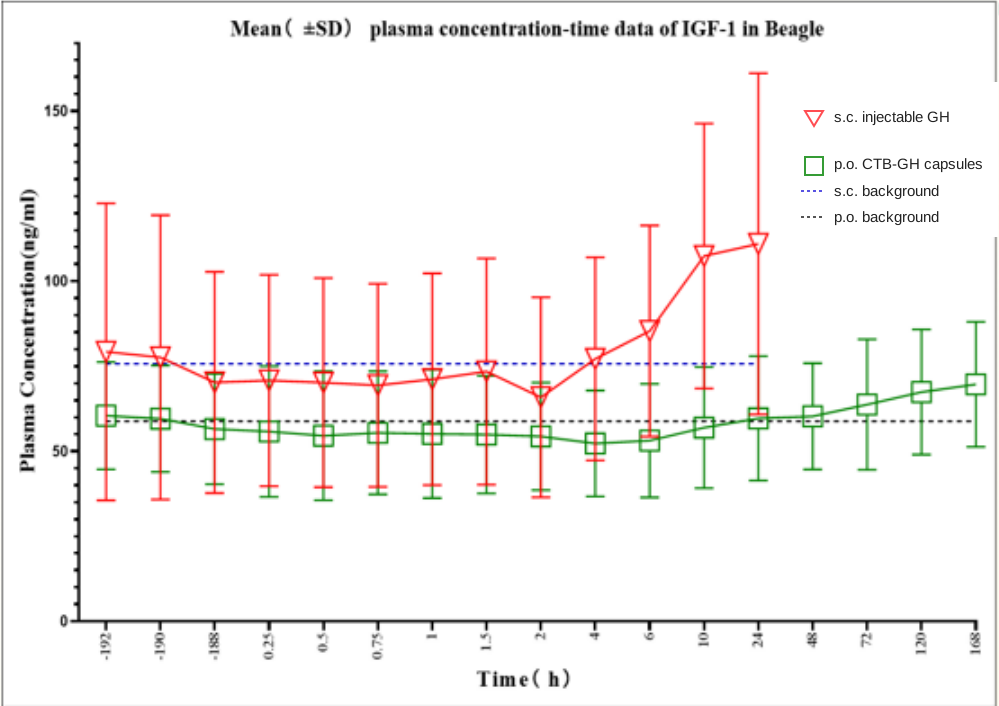
- Red triangles: s.c. injectable GH
- Green squares: p.o. material labeled CTB-GH capsules
- Dashed lines: source-labeled group backgrounds
The figure is labeled mean ± SD. Sample size, individual-animal data, statistical analysis, and the full dosing protocol are not established by this presentation extract. The plotted IGF-1 response alone does not establish oral rhGH bioavailability, efficacy, dose equivalence, or safety.
Resolve delivery and exposure together.
The project evaluates an oral rhGH approach against a subcutaneous administration route. The reported chart labels the oral material CTB-GH capsules. A specific absorption mechanism or proprietary formulation process is not established here.
The next evaluation should connect material identity and formulation composition with intact-protein exposure, dose response, and biological endpoints.
Preclinical research.
This program is presented for research collaboration. The reported animal study is not evidence of human clinical efficacy or an approved oral growth hormone treatment.
- Characterize the oral material and dose basis
- Confirm exposure and response in a defined study design
- Evaluate formulation, repeat dosing, and safety
For teams working on oral biologics.
Potential collaborations span pharmaceutical formulation, recombinant protein therapeutics, preclinical development, and translational research.
Delivery
Define the formulation question and analytical evidence needed to test it.
Evaluation
Align material characterization, PK/PD endpoints, and an appropriate model.
Translation
Assess what additional evidence is needed before advancing development.
Background for the research.
Independent publications provide scientific context. Their results do not establish performance of Lite Lab materials.
- 01
Mass spectrometry study of a transferrin-based protein drug reveals the key role of protein aggregation for successful oral delivery. Independent oral protein delivery research; not the formulation described above.
Read the publication
Discuss oral rhGH research
Share your delivery expertise, evaluation questions, and proposed collaboration scope.