
AI-Assisted Protein Design
Computational insights for targeted protein engineering.
Sequence analysis, structural modeling, and computational approaches can inform protein discovery and rational engineering.
Prioritize what to test.
Computational methods help organize evidence and select candidate variants. Sequence similarity, structural context, and an application-specific objective can guide a protein engineering discussion.
This is an enabling research capability. It is not presented as an independently validated software platform, a therapeutic product, or a substitute for laboratory evidence.
Look for conserved features.
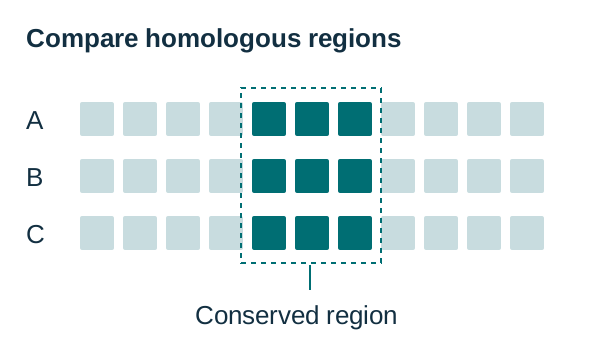
Homology analysis and multiple sequence alignment can identify conserved regions and candidate proteins for further investigation. Similarity alone does not establish catalytic activity or specificity.
- Define the sequence family and research question
- Compare homologous sequences and conserved regions
- Prioritize candidates for functional testing
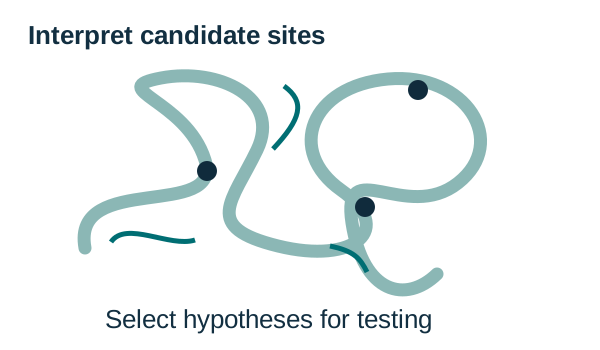
Interpret a candidate change in context.
Three-dimensional structure analysis can help identify candidate modification sites and interpret potential effects of mutations. The supplied research material references AlphaFold and structure-guided approaches.
AlphaFold is an external structure-prediction method. Model confidence, target biology, and functional evidence must be considered before using a predicted structure to guide a design.
A hypothesis becomes useful when tested.
Possible objectives include stability, activity, functional specificity, or developability. They are goals for a study, not demonstrated improvements.
- 01Define the objectiveTarget, application, and measurable evaluation criteria
- 02Analyze sequence and structureHomology, conserved features, and structural context
- 03Prioritize variantsComputationally informed candidates and rationale
- 04Produce and characterizeConfirm identity and establish material quality
- 05Test and iterateMeasure function against defined controls and criteria
Prediction is not performance.
Candidate designs require experimental confirmation. Expression, purity, stability, and functional assays answer different questions.
No quantified improvement in thermostability, activity, expression yield, or development success is claimed for Lite Lab on this page.
Connect design to target-specific production.
Protein design, experimental evaluation, and recombinant production can inform one another during development. The suitability of the chloroplast production platform should be assessed for each target.
This is a conceptual relationship, not a claim of an experimentally validated end-to-end AI-to-chloroplast pipeline.
Explore the chloroplast platformBackground for the research.
Independent publications provide scientific context. Their results do not establish performance of Lite Lab materials.
- 01
Jumper J, et al. Highly accurate protein structure prediction with AlphaFold. Nature 596, 583–589 (2021).
Read the publication
Discuss your protein engineering requirements
For protein engineering teams, enzyme developers, industrial biotechnology companies, recombinant protein developers, and research organizations.